
It's Time Vegans Stopped Arguing With History
Why some vegans reject the very strategies that built successful social movements

“Gaz Oakley is no longer anti-racist. That doesn’t mean he’s no longer an ally.”
That’s one of the top comments under Tobias Leenaert’s recent Facebook post, sarcastically mocking his recent article suggesting Gaz Oakley (the recently announced ex-vegan influencer) could still be an ally despite no longer being vegan.

Another commenter announced they now partake in domestic abuse of their husband, for health reasons, but requests to please make a post about how much of an ally they still are. Someone else asked if a feminist who beats his wife every day is still a feminist. Racists in anti-racist movements, child abusers in anti-child-abuse groups. Scroll the thread and you’ll find various versions of the same comment.
Before we get into it, I’d like to share something very relevant: I used to make these exact arguments myself. For years. I also criticised Tobias specifically. I would say things like “he’s just a welfarist” and a “fake vegan”. Actually, I said these sorts of things about anyone who promoted any message other than “go vegan”, or anyone I decided was being “apologetic”. I’m not writing this to look down on anyone, and if you read to the end I think that’ll be clear. I’m also not writing it to let Gaz Oakley off the hook, I criticised his decision in my last post. I’m writing it because I know these arguments well. They used to be mine.
“Would you say that in this situation?!”
The argument usually goes like this. Someone suggests something pragmatic, in this case, that a person who isn’t vegan, Gaz, could still be useful to animals. The response is to swap the animals out for humans.
“You’d never call a racist an ally to Black Lives Matter.”
“You’d never welcome an abuser into a group for abuse survivors.”
“So why would you do it for animals? Aha, gotcha. You’re a speciesist. You hold animals to a lower standard, and that’s exactly why animals are never going to win.”
I remember how satisfying it was to use these arguments. And if you ask:
Should we use strategic, incremental activism?
Should we aim for and take welfare-level wins along the way?
Should we ally with people who aren’t fully on our side, who might even be participating in or profiting from the thing we’re trying to end?
You’ll get “no, no, and no.”
But that’s where things start to fall apart. Because the movements people are using to make these comparisons actually did all three. Almost every successful movement in history did all three.
How they actually won
Take the issue that gets used the most: slavery. After years of using the types of arguments we just talked about, I had a very rude awakening when I learned the actual strategies of slavery abolitionists.
The campaigners who founded the British abolition movement in 1787 made a choice at the very start. They didn’t campaign to end slavery, they campaigned to end the transatlantic slave trade, the shipping of people, while slavery itself stayed completely legal. That was the strategy. Go for the smaller, winnable ask first. Slavery itself wouldn’t be abolished for another 46 years.
It gets even more interesting. In 1806, they passed a bill that dramatically reduced the trade. They got it through partly with the votes of slave owners, because it happened to serve the slave owners’ business interests. Allying with the people committing the atrocity, everything the comment section says you should never do.
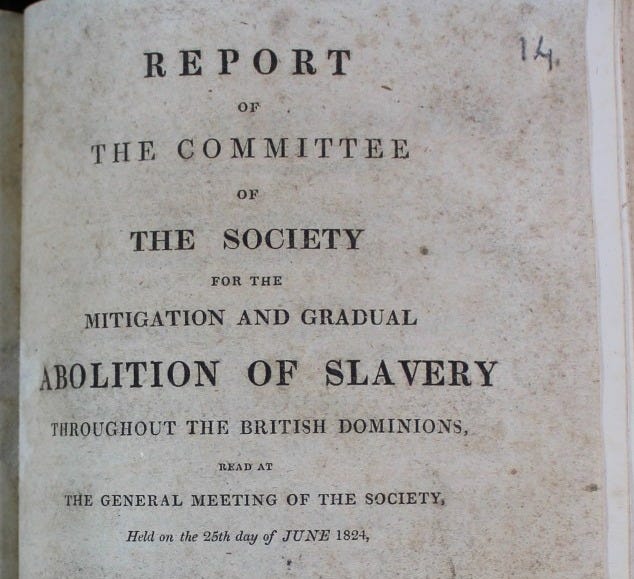
And when the movement finally turned to slavery itself in 1823, the organisation they founded was officially called the Society for the Mitigation and Gradual Abolition of Slavery. “Mitigation” and “Gradual”. In the name. One of the most important anti-slavery organisations in history put “make slavery less bad” before “end slavery” in its messaging, and spent years campaigning for legally enforced welfare improvements for enslaved people while slavery continued.
Imagine a vegan organisation today calling itself the Society for the Mitigation and Gradual Abolition of Animal Exploitation. You already know what the comments would say, but that organisation ended slavery in the British Empire.
Even the final victory came with huge compromise. The 1833 Act handed £20 million to slave owners as compensation. Around 40% of the government’s entire annual budget was paid to over 40,000 people for the loss of their “property”. The freed slaves got nothing. Most of them had to keep working unpaid for years under an “apprenticeship” system. The abolitionists took the deal, because the deal ended slavery.
But it’s not just Britain, and it’s not just slavery.
Frederick Douglass, a man who escaped slavery himself, allied with and campaigned for Abraham Lincoln. The same Abraham Lincoln who had enforced laws forcing escaped slaves to be returned to their owners, who promoted shipping black Americans out of the country, a man Frederick Douglass himself publicly called the white man's president. And he worked with him anyway, because he understood that this deeply flawed ally was the fastest road to ending slavery.
Martin Luther King Jr. stood next to Lyndon B. Johnson as he signed the Civil Rights Act of 1964. Johnson had spent twenty years opposing every single civil rights measure that came up for a vote. He once called the push for this legislation a farce and a sham. He then passed watered-down civil rights bills in 1957 and 1960, which many advocates of the day hated. But those weak bills built the road to the real one, and the movement worked with him through all of it.
The suffragettes accepted a law in 1918 that gave the vote only to women over 30 who owned property. Younger women, poorer women and working women were all excluded. They took the partial win, kept fighting, and got the full one ten years later.
I could keep going, but the point is that the world we live in now, where it’s unthinkable to consider a racist an ally to anti-racism, was built by people doing the exact things many vegans now condemn in the animal movement.
Reaping the rewards of strategies we oppose
So here’s the interesting situation, and I don’t know if there’s a name for it.
The vegans attacking these pragmatic viewpoints and strategies, like I did not so long ago, are actually reaping the rewards of the strategies they now oppose for animals. The reason the comparisons to slavery, feminism and other issues work is because they’re shocking. The idea of a racist being part of the solution to a group opposing racism? Unthinkable. And that’s because those movements were so successful. They were successful because of incremental wins, welfare-level changes, and alliances with deeply imperfect, even complicit people. The strategies worked so thoroughly that people can no longer imagine a world where they were ever needed.
The vegans opposing the use of these strategies now, are using the results of the strategy to argue against the strategy. I find that last sentence tricky to get my head around, even though I wrote it, so let me try and make it clearer:
Most successful social justice movements succeeded at least in part by using pragmatic strategies, often compromising and making imperfect alliances along the way
This led to racial and sexual discrimination, for example, being punishable by law, as well as other issues, and created a society that largely condemns many of these issues
As a result, the society we now live in couldn’t imagine ever compromising or making imperfect alliances. Those movements were so effective at changing society that it seems unthinkable
Modern-day advocates argue against compromise and imperfect alliances in the animal movement by asking if you would ever do that for say issues pertaining to racism or sexism, when the reality is that did happen, and the only reason they find the thought so repulsive is because of the success of said movements that used those strategies
In conclusion: they’re using the results of the strategy to argue against the strategy
We can’t have it both ways.
Either we stop making those specific comparisons, because we reject how those movements actually got to where they are. Or we keep making them, and we accept that the only reason we can, is that those movements did exactly what people like Tobias are suggesting we do now.
When those movements were in their infancy, when the thing they opposed was normal, legal, and practised by almost everyone, they compromised. They took partial wins and they worked with people complicit in the harm. The animal movement is still in its infancy right now. Over 95% of the world participates in the thing we oppose. We are where they were when they did all of this.
To be clear, I’m not saying we can never compare animal issues to human ones. I just did. This entire article is built on those comparisons. The comparison between the victims is valid. A pig’s suffering doesn’t matter less because she’s a pig, that’s the whole point of rejecting speciesism. What doesn’t always track though is when we’re comparing across time. The “gotcha” statement of “you wouldn’t do this with racism” for example takes today’s attitudes to racism, attitudes that only exist because the movement already won (mostly), and applies them to a movement that hasn’t won anything close to that. If we’re going to compare, it should be like for like. Compare us to the abolitionists of 1787, not to the anti-racists of 2026. And the abolitionists of 1787 did a lot of what people like Tobias are suggesting.
The strongest version of the objection
I want to discuss the best counter-argument to all of this.
Someone could say: “There’s a difference between working with imperfect people and celebrating them”. Abraham Lincoln and Lyndon B. Johnson were flawed men moving toward the cause. Gaz is moving away from it. He didn’t just fall short of veganism, he left it, publicly, while participating in the harm itself.
I think that’s the real reason it stings so much. But notice what the objection has become. It’s not “you can’t ally with imperfect people”, it’s now an argument about how we treat one specific person who left. And that’s a much smaller claim. It doesn’t touch welfare wins, it doesn’t touch strategic alliances. It’s basically just a disagreement about Gaz Oakley’s Instagram.
And even on that smaller question, I’d ask: what does treating him as an enemy actually achieve for animals? I write more on how to respond to ex-vegans here.
Here’s what I think it achieves: not much good. I’m disappointed in Gaz too, but what concerns me far more than Gaz Oakley is the multibillion-dollar animal agriculture industries that spend hundreds of millions every single year on marketing and PR, designed and implemented by teams with decades of experience in manipulating the public into buying their products and turning on vegans. I think that’s where most of our energy should be going.
So why are some so focused on Gaz instead? I think it’s because, unlike those industries, Gaz is a real face with a real name. We can see him, we can DM him, we can attack him online as one individual person. He’s a face of something we disagree with. The industry has no face. But in the grand scheme of things, his influence is a grain of sand compared to what we’re actually fighting.
And he could become a useful tool for them, if we keep pushing him that way. Or he could keep being a tool for the animal movement. Gaz said himself, in his own post, that he still opposes factory farming. Guess where the majority of that funding, advertising and psychological manipulation we mentioned comes from? You guessed it, factory farming. So we have a choice: push him to the point where the only place he feels accepted is among agriculture interests and the people who support them, or hold onto the fact that he could still be useful to the animals. Encourage that and show him the way. That’s probably the stuff we should be DMing him.
What allies can do
Allies aren’t just people we tolerate. They can be tools for good, if we allow it.
Liv Boeree is a poker champion, and not a vegan. She saw a single post about a pig in a crate and couldn’t shake it. So she pledged 20% of her next tournament winnings to factory-farmed animals, then won $2.8 million. She donated $560,000 of it. And the money was just a small part. She started talking to her huge following about factory farming, and she got Lewis Bollard, one of the most important funders in our movement, onto the main TED stage. Possibly the first talk in TED’s history dedicated entirely to factory farming, because one non-vegan decided to open a door.
Lewis Bollard then went on Dwarkesh Patel’s podcast (1.3m subscribers). Dwarkesh isn’t vegan either. He pledged to match $250,000 in donations to fight factory farming, and his audience, tech people, most of whom had never engaged with animal issues in their lives, met it within two days. The Stripe CEO Patrick Collison threw in another $250,000 match. Within weeks the fundraiser hit $2 million. That’s about 1% of what the entire global movement raises in a year, from one podcast episode hosted by a non-vegan.
Anyone who takes issue with this has probably never tried fundraising for animal causes. It’s incredibly hard. Practically everything we want to do for animals requires funding, and, as Lewis Bollard pointed out, the entire global budget for farmed animal advocacy is smaller than what one New York museum spends in a year. These people didn’t go vegan, but they moved real money and real attention to the animals anyway. I don’t think we’re in a position to turn away friends like that, even if we (and the animals of course) would rather they were also vegan.
I don’t like it either
I want to be honest about something else. This softer messaging, the welfarism, the reductionism, the allies, I’m not a huge fan of it. I don’t like it. Also, I know Tobias Leenaert personally, and it’s not his preference either.
I have seen what we’re doing to these animals. I’ve seen the pain in their eyes. I’ve been undercover, and I swear some of the animals looking right back at me were begging me to help them. But I couldn’t. It breaks my heart to think about it.
So yes, it feels wrong to suggest incremental change, reductionism, welfare. It feels wrong to consider someone funding anything like this an ally. But there’s a difference between feelings and reality. It might not feel right for you. It doesn’t for me, which is why I don’t do it in my advocacy. But I still acknowledge it as a valid strategy. There is historical precedent for the success of these strategies, and we have decades of research in psychology and human behaviour that give them a lot of backing. There can be a distinction between:
What you like
What you’d personally do
What you can acknowledge probably works
Not every strategy will fall into all three categories, and that’s okay.
A compromise we accept
If you still think compromising for the greater good is never acceptable, I want to give you one example that I think most vegans already agree with.

Undercover investigators.
Investigators get jobs in slaughterhouses, on farms, inside hunting groups, to document what happens there. And that work requires them to do things to animals that they are completely against. Things they’d never otherwise do. It goes against everything they believe. But they understand that a compromise has to be made for the greater good. To expose it, to change the world, they have to go into the belly of the beast.
Most vegans understand this. Most vegans benefit from it. A huge number of vegans went vegan because of these people and the footage they brought out. It shifted their entire paradigm. To turn on investigators and say “you shouldn’t do that, it’s against vegan principles”, when the only reason we hold vegan principles is their work, would make no sense.
Telling the people using the best research we have on human behaviour and movement strategy that they shouldn’t do it because it clashes with your principles is the same move. It’s telling the investigator not to investigate.
Where this leaves us
Compromises have to be made, and we’re not always going to like it. It’s dirty, it’s messy, because life is dirty and messy. It’s nearly impossible to go through life applying our principles religiously to every single situation, especially if we actually want to change anything.
And to be clear, the principles are valid. I hold them. This isn't about abandoning them, and it isn't about abandoning our feelings either. I get very angry too. It's about channelling that passion and emotion into what is likely to get the best outcomes for animals. Public anger is a powerful tool, but it works best in a world where the majority already agrees with us. That's the world these strategies are trying to build. No one can say that these strategies offer a 100% foolproof way to win for animals, but we should at least view them as valid strategies to try and win.
If pragmatism and uncomfortable alliances are what it takes to reach a world where exploiting animals is so unthinkable that nobody would ever do it, where the comparisons made in that comments section at the start actually work, because the job is finally done, isn’t that something we should consider? It seems the movements we keep using in our “gotchas” answered that question a long time ago.
Have you used these comparisons yourself? Where do you stand on it now?
Damn I had absolutely no knowledge about that aspect of the abolitionist movement. Thanks for writing all this up, that's pretty mindblowing
Great read :-)